
Thread standards you should know
Thread standards ensure that components remain interchangeable and that your work results are reproducible at all times. This is particularly important if you want to cut threads yourself. Which thread standard should the tap have and why does your spare part not fit as you had imagined? As a manufacturer of threading tools with 40 years of company history, we hear these and similar questions every day at BAER. To prevent confusion and clarify the most important key data, we have compiled an overview of the most common thread standards for you
You should have already heard of these types of threads
Thread standards abound - from widely used standard threads to obscure special cases. However, in order to find your way around in your daily work as a do-it-yourselfer or craftsman, a few thread standards will suffice as a point of reference.
The ISO metric thread (M)
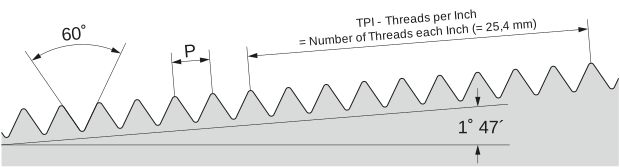
Since this type of thread is used very frequently in Europe, you have probably already worked with it yourself. The thread standard for the metric standard thread is a fastening thread that is used, for example, for screws and nuts. It has a flank angle of 60° and is identified by the abbreviation M and the nominal diameter. Since this is a metric thread standard, all dimensions are given in mm.

The ISO metric fine thread (MF)
This type of thread is a variant of the ISO metric standard thread with a smaller pitch and thread depth. The small pitch in the MF metric fine pitch thread makes it possible to determine the position of a screw very precisely. The thread standard is therefore often used for adjusting screws. In addition, fine threads with this standard have good self-locking properties and, thanks to their shallow depth, can be used even where space is limited. The abbreviation MF is used for the thread designation.
The trapezoidal thread (Tr)
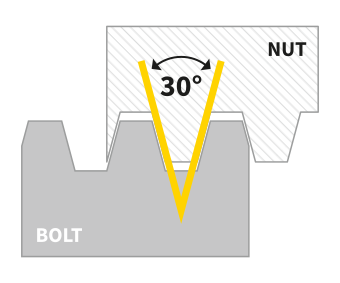
The trapezoidal thread is also a metric thread standard, accordingly all dimensions are given in mm. The flank angle here is only 30°. A striking feature of this thread is the profile, which is not pointed, but rather has the shape of an isosceles trapezoid. This makes the trapezoidal thread well suited as a movement thread and in this capacity it can be found in lathes or screw presses, among other things.
Unified National Coarse Thread (UNC)
At this point we enter the field of American thread types. With a flank angle of 60°, the American coarse thread is similar to the metric ISO thread and is also roughly the equivalent of this thread standard in the USA in terms of function and distribution. It is important to note that all dimensions are in inches. Also, in the case of American threads, the pitch is given by the number of threads in inches. A small but important detail that can be confusing at first glance.
Unified National Fine Thread (UNF)
As with metric threads, there is a fine thread to the coarse thread in American threads. The flank angle of the American fine thread is 60° and here, too, all specifications must be made in inches. Like the UNC thread standard, the UNF thread standard is also widespread worldwide and is used not only in the USA but also in Japan and Australia, among other countries.
Unified National Special Thread (UNS)
The UNS thread standard is a special standard for threads. This standard also has a flank angle of 60°, but differs from the other American threads by special diameters, pitches and screw-in lengths. This American thread with special pitch can be found, for example, in microphone stands.
National Standard Taper Pipe (NPT)
While the NPT thread is also one of the American thread standards, it is not part of the Unified Thread Standard (UTS). Rather, it is part of a group of standards for pipe threads. The American pipe thread is tapered, non-sealing, and has a flank angle of 60°.
British Standard Whitworth Coarse Thread (BSW)
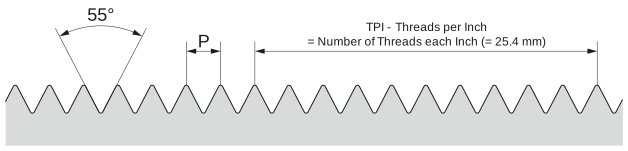
Let's continue with the British threads. The British coarse thread is the standardized standard thread in the UK, similar to the metric thread standard in mainland Europe. The dimensions are given in inches. Be careful with the flank angle, because it is only 55° here. The thread abbreviation for this thread standard is composed of the abbreviation BSW and the nominal diameter in inches.
British Standard Fine Thread (BSF)
The British thread standards also know the fine thread to the BSW thread. The British Standard Fine Thread (BSF) has a flank angle of 55°. The British fine thread used to be an important part of the glorious British automotive industry, but has since lost importance. You can recognize this thread by the thread designation BSF followed by the diameter in inches.
British Standard Pipe Parallel (BSP)
While the other British thread standards are mainly used in their country of origin, the BSP pipe thread is also very popular outside the borders. It has become the standard thread for connecting pipes in plumbing and heating technology and you may therefore encounter it in Germany as well. You must note that this thread standard also has a flank angle of 55°. In addition, the inch specifications in the thread designation are not to be taken literally, as they refer to obsolete pipe geometries. The abbreviation for the BSP thread is G.

Buy taps according to thread standards at BAER Online-Shop
You can find all these thread types and much more in our BAER Online-Shop . As a tap manufacturer, we carry taps, dies and other useful tools for all common metric and imperial thread standards. But also special cases you will not look in vain with us. From valve threads to bicycle threads to special threads for the aerospace industry - at BAER you can get everything from a single source and of outstanding quality that will inspire you. And if no thread type covers your very special application, then we can produce the tap of your dreams entirely to your specifications on request.